Arnold Schlick, Berliner Bär, 1963, 51°57'22.7"N 7°37'59.6"E
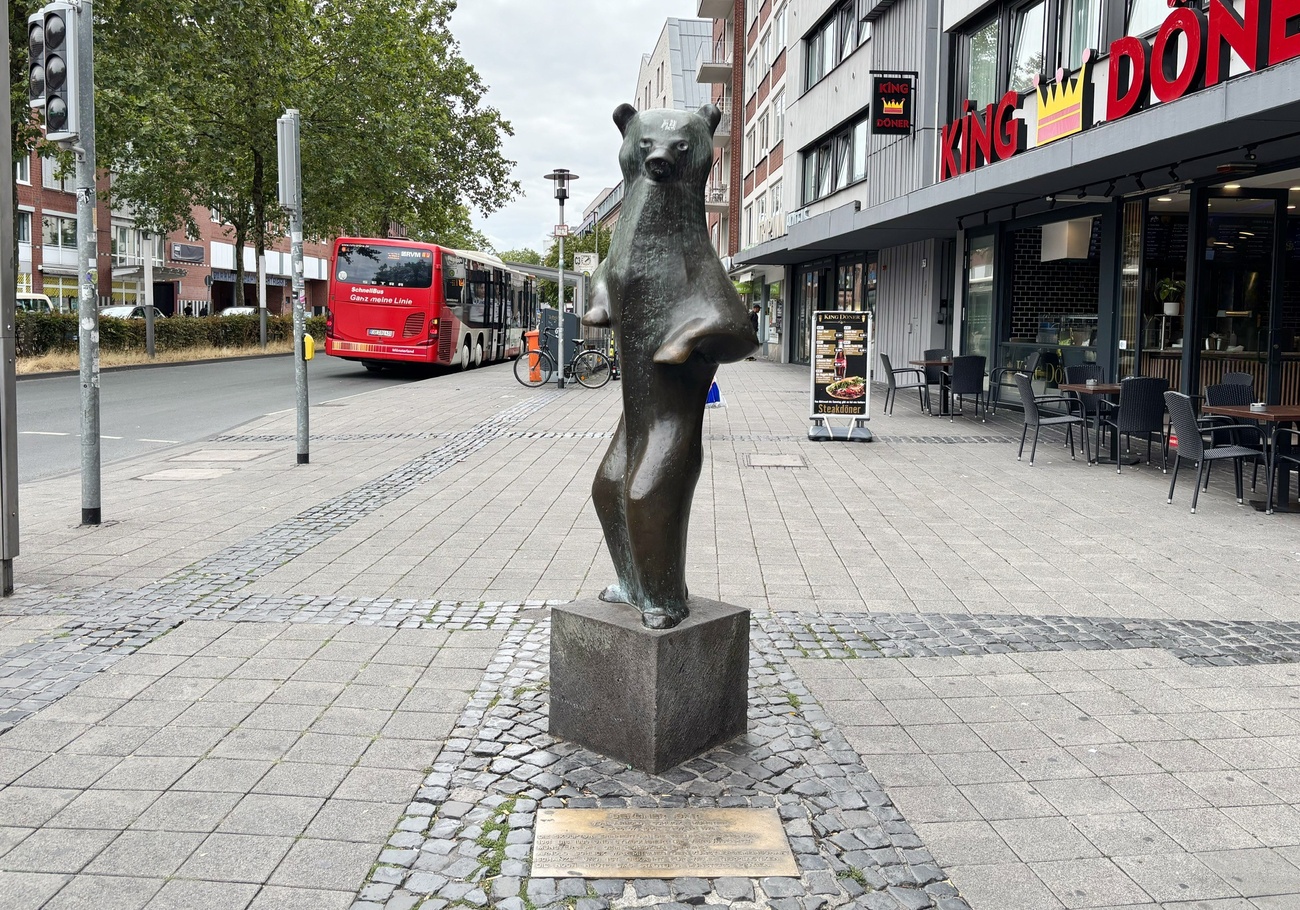
Arnold Schlick, Berliner Bär, 1963
Arnold Schlick’s (1896–1978) lifelong fascination with the animal world is reflected in many of his works, most of which he created in Münster, where he lived from 1925 onwards. His animal sculptures are stylized representations marked by a fluid style. The Berliner Bär (Berlin Bear), a bronze sculpture standing upright on a plinth, is such a characteristic piece. Both hind legs are firmly an-chored to the plinth, while the bent forelegs present the slender body in a slightly tense yet balanced posture. In its upright position, it appears as a majestic creature that radiates strength and dignity. Its posture conveys a calm presence combining power and serenity. Schlick had originally planned a “dynamic attack position” for the bear, but this was altered in favour of a more restrained and less threatening posture with angled forelegs.1
The sculpture was created by Schlick on occasion of the construction of the Berlin Wall and was first erected on Berliner Platz in front of Münster’s main railway station in 1963. After being moved in 1993 and also temporarily dismantled, the bear has returned to its original location since 2002, now facing in a different direction. Since 2006, a bronze information plaque in the pavement com-plements the sculpture, with an inscription referring to Berlin’s division between 1961 and 1989 and highlighting Münster’s sympathy regarding this fate. The bear, a symbolic figure of Berlin, visualizes solidarity with the divided capital, which became the centre of the Cold War after World War II. The deliberate placement of the sculpture on Berliner Platz, whose name already refers to the relation-ship, underscores Münster’s connection to the history of Berlin.
In addition to the Berliner Bär, numerous other sculptures by Schlick define Münster’s urban space. Examples include the Gänsegruppe (Goose Group, 1950) on the bridge over the river Aa at Spiekerhof and the Altum-Denkmal (Altum Monument, 1962) in the form of an owl on the promenade. Schlick’s influence on the cultural life of the city went far beyond his works in public spaces. As a member of the artists’ community Schanze founded in 1919—an association shaping cultural life in Münster to this day—he also made a significant contribution to the promotion of modern art.2
Luca Scholz
Cf. Ursula Uber, Freiplastiken in Münster (Münster: C. J. Fahle GmbH, 1977), 92.
Cf. Bärbel Jäger, “Zum Hundertsten: Die Geschichte von Kontinuität und Wandel der Freien Künstlergemeinschaft Schanze in Münster,” in Freie Künstlergemeinschaft Schanze e.V. (ed.): 100 Jahre Freie Künstlergemeinschaft Schanze (Münster: Daedalus, 2019), 25–54; Annette Georgi, “Heutige Künstlerinnen und Künstler der Freien Künstlerge-meinschaft Schanze e.V.,” in ibid., 79–110.